

ELECTRIC CIRCUIT BREAKER CAPACITORS
Switching Capacitors
The circuit breaker is a patented device that allows single-phase asynchronous motors to start even under load. These motors comprise a main winding and an auxiliary winding; the latter is permanently connected to a capacitor Cr (run capacitor), while another capacitor Cs (start capacitor) remains connected only for a short period, typically a few seconds. Each time the motor is started, the start capacitor Cs is connected in parallel with the run capacitor Cr to increase the motor's starting torque. After a sufficient amount of time for the motor to reach a speed of approximately 75% of its maximum speed, the start capacitor is disconnected and discharged into a resistor.
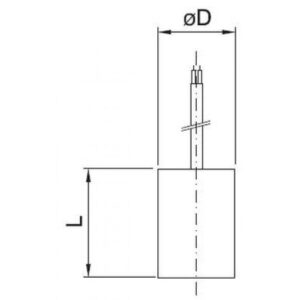
Flat bottom model - 300 mm
unsheathed 40 mm stripped 10 mm
TS 1.5 sec.
T off 0.5 sec.
The switching capacitor is a patented device that helps single phase asynchronous motors to start even if under load. These motors have a main winding and an auxiliary one; the last one is connected in a permanent way to a capacitor Cr (running capacitor) while another capacitor Cs (starting capacitor) is energized only for a short time, generally few seconds.
At every motor starting Cs (starting capacitor) is connected in parallel to Cr (running capacitor) in order to increase the motor static torque; after a sufficient time for motor to reach a speed of about 75% of the maximum speed, starting capacitor is disconnected and discharged through a resistor.


